Forum Network Statement on ADB’s Energy Crisis Response in Asia and the Pacific
As the Israel-US-Iran war hit, Asia and the Pacific region are at the crossroads of multiple crises: economic, environmental, and energy. The Middle East war has further exposed the region to the risks of economic slowdown. In its Asia Outlook, the Asian Development Bank projected that if the war persisted up to the third quarter of the year, developing countries would experience a downward growth to 4.7%, with Asia especially vulnerable because about 80% of oil and gas passing through the Strait of Hormuz is headed for the region. Moreover, the prices of fuel are exceptionally high in Asia, with Laos (~2.33 USD/liter), the Philippines(~2.15 USD/liter), Cambodia (~2.05 USD/liter), Pakistan (~1.87 USD/liter), and Myanmar (~1.81 USD/liter) being the top 5 most affected. As the prices of fuel continue to spike since the start of the war, the prices of basic commodities and the costs of mass transportation have shaken the economies and basically put everyone in survival mode.
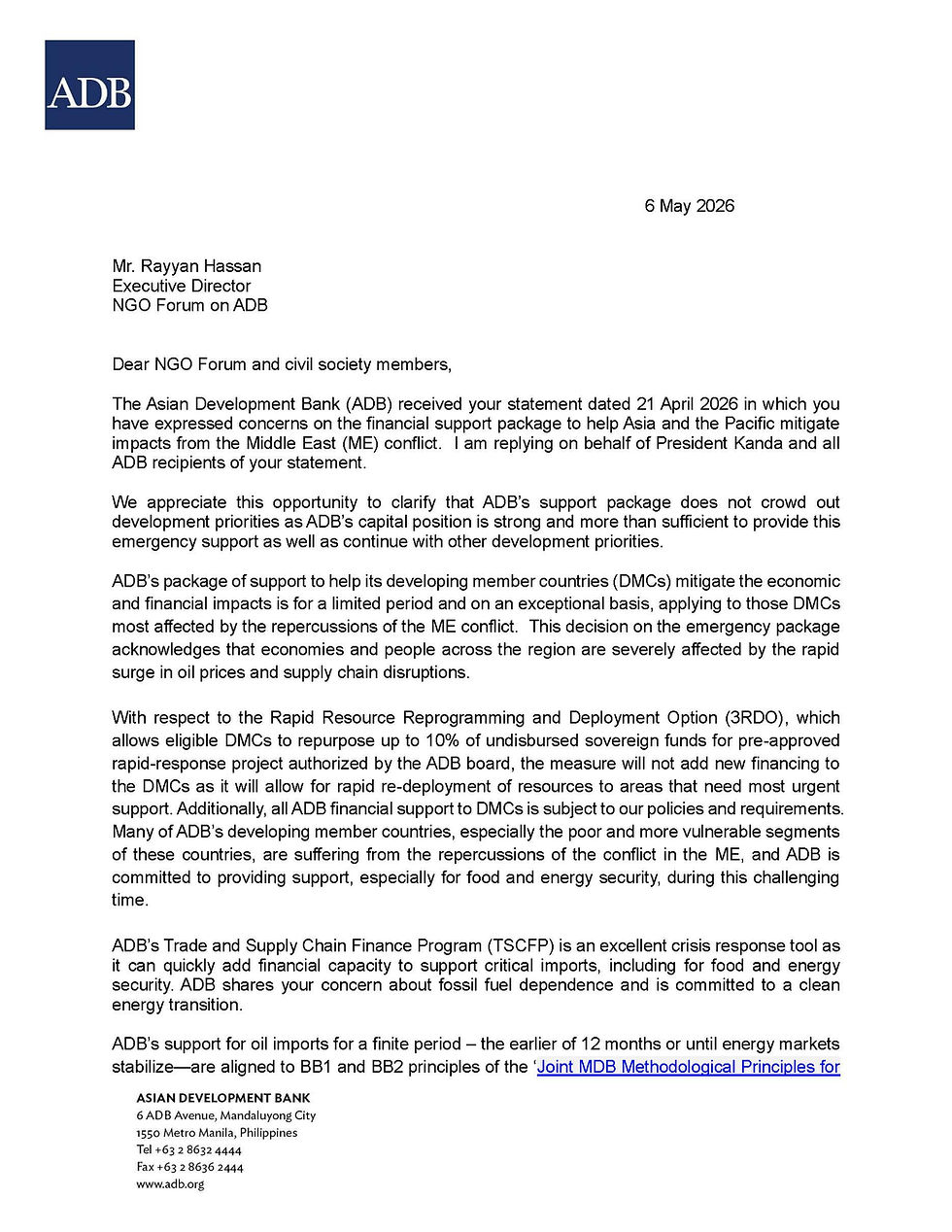
Against this backdrop, ADB has introduced a support package framed as emergency relief. One pillar is the Rapid Resource Reprogramming and Deployment Option (3RDO), which allows eligible Multilateral Development Banks, like the ADB, to introduce financing facilities in the guise of a crisis response to aid Asia and the Pacific. This mechanism, which they call 3RDO or Rapid Resource Reprogramming and Deployment Option, was intended for developing member countries, enabling them to repurpose up to 10% of undisbursed sovereign funds (25% for small island states) for a pre-approved rapid-response project authorized by the ADB Board. This is also coupled with reactivating support for oil imports under its Trade and Supply Chain Finance Program on an exceptional basis.
ADB’s package is heavily linked to a broader privatisation agenda that benefits the wealthy while risking hardships for others. Its reactivated Trade and Supply Chain Finance Program explicitly supports the private sector in maintaining critical imports, including energy and now oil. Civil society has also documented how ADB’s energy structure has gradually created more space for private sector-led energy models.
The overall effect of these packages is deeply problematic. Economically, it may offer short-term liquidity and import cover, but it does so by reinforcing dependence on volatile fossil-fuel markets at a time when high import bills are already worsening inflation and debt stress. Rather than reducing structural vulnerability, the package risks socializing the costs of fossil-fuel dependence while preserving the commercial position of private importers, banks, and energy-linked firms. In countries already struggling with debt service, repurposing sovereign resources and leaning further on debt-backed interventions can crowd out spending needed for food security, transport support, public services, and long-term resilience.
This is also a clear example of ADB backsliding on climate responsibility. ADB claims it is dedicated to full Paris alignment, increasing climate finance to 50% of annual committed funding by 2030, and promoting a just transition to a low-carbon economy. According to ADB, they stopped doing oil import transactions (through TSCFP) by July 2023. In the 2025 Energy Policy Review, there was an attempt to cease the remaining oil import transactions to Pakistan and Sri Lanka under the TSCFP. Unfortunately, this crucial amendment was not done. Although it was not articulated in the policy, a Board Decision in June 2024 stated that it would finally halt the transactions for both countries by July 2025 due to their Paris Alignment commitments. However, the current announcement by the President of resuming oil import transactions is a clear violation of its climate commitments and the Board's recommendations in the past years.
In addition, the continued reliance of many Asian countries on imported oil and gas leaves countries exposed to price volatility and supply shocks. In contrast, faster clean-energy deployment would reduce those risks and sharply lower future fossil-fuel import bills. By reopening support for oil imports, ADB is helping entrench the very fossil-fuel dependence that amplifies economic insecurity, sustains emissions, and delays a transition to more stable, domestic, and affordable renewable energy systems. In that sense, the package is not a neutral crisis response but an intervention that locks countries more tightly into debt, fossil dependence, and climate vulnerability.
To conclude, the war-energy-climate shall not be seen through a separate lens. Even before the Middle East crisis emerged, ADB noted that failing to shift away from carbon-intensive growth would carry severe consequences, as climate change could cut regional GDP by as much as 17% by 2070, with the heaviest impacts falling on lower-income and more fragile economies. With this, it is clear as day that this war should not be a justification for these kinds of support, not only for ADB but for all MDBs. Towards this, the Forum Network strongly calls for:
Ending the ‘emergency’ support for fossil fuel imports, particularly oil and gas. Crisis support should not reinforce fossil fuel dependence while DMCs suffer from price volatility and external shocks.
Redirecting the crisis financing to long-term energy security solutions, especially decentralized Renewable Energy. If ADB is serious about providing a long-term solution to the crisis, emergency, and reprogrammed funds under 3RDO should prioritize public and community-led energy solutions.
Rejecting debt-based mechanisms that will crowd out essential social spending during the crisis and moving away from private sector-driven energy support under the guise of emergency response.
Upholding increased transparency and accountability in emergency financing by full public disclosure of all projects, policies, and mechanisms supported.
Ensuring ADB’s adherence to its obligation under the Paris Agreement by ending fossil fuels and closing all the policy loopholes used to indirectly finance them.
Prioritizing a just and equitable energy transition in all crisis-response measures, by protecting workers and vulnerable communities, and inclusive participation of CSOs and affected communities in decision-making related to the said financing.
ADB must therefore cancel this facility and rule out any future lending with similar fossil-fuel–reinforcing objectives, because such loans would directly undermine developing member countries’ just transition pathways, deepen debt and import dependence, and push them further away from their Paris alignment commitments and climate-resilient development goals.
Endorsed by:
NGO Forum on ADB, Regional
AbibiNsroma Foundation, Ghana
Adarsha Samajik Progoti Sangstha, Bangladesh
Aksi! for gender, social, and ecological justice, Indonesia
Alyansa Tigil Mina (ATM), Philippines
Asian Peoples’ Movement on Debt and Development (APMDD), Regional
Bandhan, Bangladesh
Bank Climate Advocates (BCA), International
Bantay Kita - Resource Justice Network Philippines, Philippines
Big Shift Global, Global
Buliisa Initiative for Rural Development Organisation (BIRUDO), Uganda
Centre for Community Mobilization and Support NGO, Armenia
Centre for Human Rights and Development, Mongolia
Centre for Research and Advocacy Manipur, India
Debt Justice Norway, Norway
Fiji Women's Rights Movement (FWRM), Fiji
Freedom from Debt Coalition (FDC), Philippines
Fresh Eyes, United Kingdom
Friends of the Earth Japan, Japan
Growthwatch, India
Indus Consortium, Pakistan
Inisiasi Masyarakat Adat (IMA), Indonesia
Legal Rights and Natural Resources Center-Friends of the Earth Philippines, Philippines
Manushya Foundation, Laos, Thailand, Southeast Asia
Mekong Watch, Japan
MenaFem Movement, Egypt
Nash Vek PF, Kyrgyzstan
Oil Workers' Rights Protection Organization Public Union, Azerbaijan
Oyu Tolgoi Watch, Mongolia
Pakistan Fisherfolk Forum, Pakistan
Peace Point Development Foundation (PPDF), Nigeria
Quest For Growth and Development Foundation, Nigeria
Recourse, International
Rivers & Rights, Southeast Asia
Rivers without Boundaries, Mongolia
Society for Women Rights and Development (SWoRD) Pakistan
Solidaritas Perempuan (Women's Solidarity For Human Rights), Indonesia
Urgewald, Germany