ADB fueling the energy crisis, locking Asia into decades of destruction
Updated: Jun 11
Forum Network Statement on the 21st Asia Clean Energy Forum
As communities across Asia struggle with spiralling electricity prices, debt, displacement, and climate devastation, the Asian Development Bank continues to deepen the very fossil fuel dependence driving the crisis. The Bank’s Asia Clean Energy Forum 2026 marks its 21st year under the theme “Beyond Transition: Building Secure, Resilient, Inclusive, and Intelligent Systems.” Once again, the forum positions itself as a platform to shape the future of Asia’s energy systems, particularly in the Bank’s developing member countries. However, the Bank does so in the shadow of a deep, compounding global energy crisis. The ongoing war in West Asia has fractured global fuel supply chains, sent energy prices up, and exposed with brutal clarity how profoundly Asia’s economies remain entrenched in imported fossil fuels. For developing countries in the region, it is a daily economic emergency, with rising electricity costs, fuel shortages, ballooning import bills, and mounting debt burdens that fall most heavily on communities already living on the margins of survival.
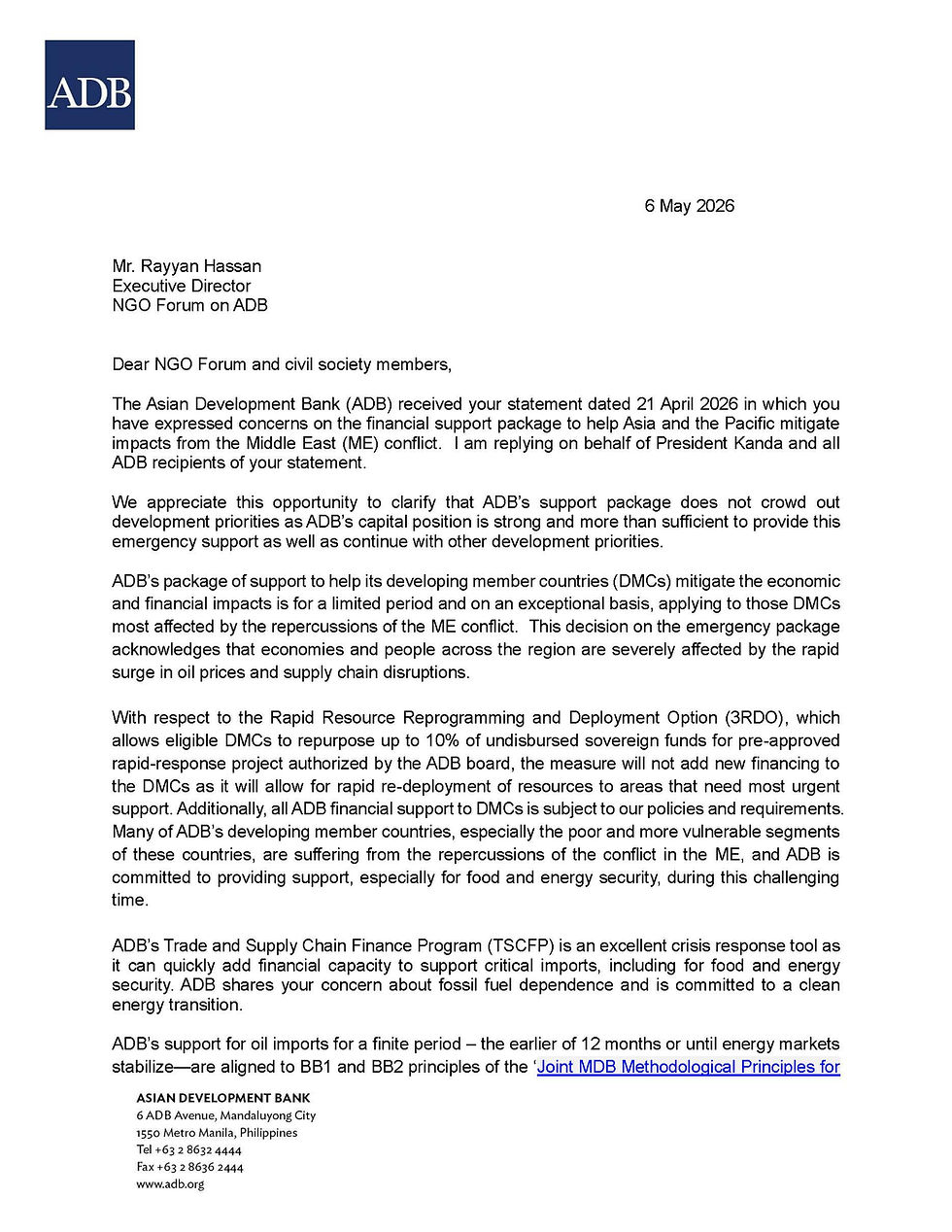
At the backdrop, ADB has revived and expanded oil import transaction support under the cover of the energy crisis through its Trade and Supply Chain Finance Program, effectively using geopolitical disruption and energy insecurity as justification for financing fossil fuel trade flows. The Bank has provided no clear public disclosure on the volume, country distribution, or environmental screening criteria applied to these oil-related trade transactions, making accountability impossible.
Further, the recently concluded 59th Annual Meeting in Samarkand, Uzbekistan, has unveiled ADB’s extensive plan of not leaving fossil fuels and false solutions. ADB also launched several major new financing facilities that demand urgent scrutiny. The Action for Creating Energy Security for Long-term Resilience (ACCEL) facility, co-financed with ADB and Japan (including Japan Bank for International Cooperation (JBIC), carries particular risks. JBIC has one of the worst track records among bilateral development finance institutions for continued fossil fuel financing. The absence of binding exclusion criteria in ACCEL's operational framework raises serious concerns about fossil fuel co-mingling and corporate capture of the facility's investment pipeline. The Regional Financing Facility for Critical Minerals, designed in coordination with Western Bloc partners, similarly channels public resources, in the form of grants, loans, and guarantees, primarily toward private sector mining ventures, accelerating extraction without the binding free, prior, and informed consent requirements, no-go zones, or traceability standards that affected communities have demanded. The Pan-Asia Power Grid Initiative, a multi-billion-dollar fund announced to support cross-regional electricity supergrids, remains opaque on project selection criteria, community governance provisions, and the role of private financiers in shaping grid architecture across sovereign territories, without regard for transboundary environmental and social impacts, let alone remedial action. This is what the CSOs, trade unions, social movements, and communities across Asia and beyond have raised for decades, that public money mobilizes private capital, but accountability to affected communities and transparency on project selection are absent or inadequate.
Moreover, the ACEF’s rhetoric of secure and inclusive systems masks a growing and urgent contradiction. ADB’s 2025 Energy Policy Review, which could have been the moment to decisively close the door on fossil fuels, has instead retained fossil gas as a so-called “transition fuel” without a sunset clause or credible phase-out pathway. It opened space for nuclear energy and critical minerals extraction. It continued to promote carbon capture, co-firing, and fuel switching as climate solutions despite mounting evidence that they prolong fossil fuel dependence and lack proof of concept at scale.
And critically, the Bank’s response to the energy crisis has been to expand its private sector operations dramatically, wherein a record amounting to USD 2.6 billion was committed through several private sector transactions in 2024 alone, partnering with corporate actors whose documented track records of environmental harm, human rights violations, and fossil fuel entrenchment stand in direct contradiction to the Bank’s rhetoric on just transition. For instance, the ADB has funded its first critical minerals project with Barrick Mining, the Reko Diq copper-gold project, which is now facing significant security risks as it is being implemented in Balochistan, a heavily militarized area in Pakistan. KEPCO, a direct interlocutor with ADB on coal transition mechanisms, has expanded coal capacity across Indonesia and Vietnam despite its government’s stated climate commitments. Meanwhile, its subcritical coal plant in Cebu emits an estimated 75 percent more CO₂ than modern alternatives and has caused documented community health devastation. Marubeni's Cirebon 1 coal power plant, the centerpiece of ADB's ETM in Indonesia, is responsible for air pollution, heavy metal contamination of coastal waters, and deaths from air pollution, while a parallel Cirebon 2 plant developed by the same parent company continued construction, and is now operating, alongside the retirement negotiations. These are ADB’s partners and will be present at this year’s ACEF. And their records are inseparable from the energy crisis that ADB’s forum claims to be solving.
ADB’S ENERGY POLICY GAPS, LOCKING ASIA IN PROLONGED CRISIS
The Bank’s energy policy review last year left critical gaps that will definitely extend fossil fuel dependence when the energy crisis demands the opposite. CSOs, communities, and energy justice advocates have raised these concerns repeatedly in policy review engagements, bilateral meetings, and formal submissions. The response has too often been that the gaps are “not the intention” of the policy.
On Fossil Gas. Fossil gas remains labeled a “transition fuel” with no sunset provision and no clear phase-out pathway. The Rupsha 800-megawatt LNG project in Bangladesh, built with billions in investment. It is a textbook stranded asset, and it is locking Bangladesh into a high-carbon, import-dependent energy pathway at precisely the moment when import volatility is devastating the country’s economy. Moreover, some cases of technical assistance pertaining to “clean energy transition” are deeply exposed to fossil gas. If ADB continues to finance gas infrastructure and opaque technical assistance across its DMCs, it is financing carbon lock-in, stranded assets, and long-term vulnerability for the countries least able to absorb those costs.
On Coal Policy Loopholes. Even after ADB’s formal coal ban, loopholes enabling both direct and indirect coal financing have persisted and were not adequately closed in last year’s midterm review. The Jamshoro 660-megawatt coal plant in Pakistan continued to receive ADB disbursements after the 2021 Energy Policy was adopted. This is indeed a direct contradiction of the Bank’s own commitment to no new coal financing. This constitutes a breach of the Do No Harm principle and ADB’s safeguards obligations. Moreover, critical gaps enabling indirect coal financing through financial intermediaries remain open, in violation of the Bank’s own Paris-alignment claims.
On ETM. The Energy Transition Mechanism was designed for early coal retirement. In practice, it has shifted toward asset repurposing through unproven technologies, wherein co-firing, fuel switching, and partial recommissioning are seen in the proposed pilots in Indonesia, the Philippines, and Kazakhstan. A proposal to expand its scope to oil and gas was floated last year without resolving standing civil society concerns. ETM processes remain opaque, lacking meaningful community engagement or transparency. Rather than closing coal plants, the ETM risks becoming a financial mechanism that extends their operational lives under a cleaner-sounding label. At the same time, the energy crisis deepens the fiscal pressure on DMC governments to keep polluting plants online.
On Critical Minerals Mining. ADB's Critical Minerals to Clean Energy Transition initiative is green extractivism by another name. From its co-financing of the Marcopper disaster in Marinduque to the Reko Diq loan approved in militarized Balochistan before the Bank had conducted due diligence on the risks of becoming implicated in gross human rights violations, including the forced disappearances and militarization that define the region, the Bank has consistently moved ahead of accountability while communities bear the consequences. Classifying destructive mining as part of the broader climate finance does not make it clean energy. ADB must not expand its extractives agenda until binding free, prior, and informed consent, including the right of communities to say no, no-go zones in Indigenous and conflict-affected territories and transboundary ecosystems, measures ensuring that resource extraction does not contribute to further militarization and conflict, and full mineral traceability are in place.
On Nuclear Energy. With lead times of 9-11 years from planning to commissioning, prohibitive upfront capital costs, and uranium supply chains that replicate the geopolitical vulnerabilities of fossil fuels, nuclear energy cannot respond to the region's urgent and immediate energy deficits. No widely accepted solution for long-term nuclear waste disposal exists, with only one operational repository in the world. Apart from this, DMCs have yet to meet the IAEA's Safety Requirements for nuclear readiness, and the Bank must not push nuclear energy on countries that are not prepared to safely and equitably absorb it. Yet ADB's 2025 Energy Policy has opened the door to nuclear financing, with its de-risking model likely to socialize construction risks and cost overruns onto the public balance sheets of developing member countries, while profits flow to multinational corporations shielded by stabilization clauses and arbitration mechanisms that constrain host governments' ability to renegotiate. For the Global South, this means locking scarce fiscal space into a long-gestation, high-risk technology instead of the rapidly deployable, community-centered renewables that the crisis actually demands.
On False Energy Solutions. For years, Forum Network has strongly campaigned for ADB to stop financing false energy solutions, such as large-scale hydropower projects, geothermal power plants, and waste-to-energy incinerators, branded as “renewable” but delivering social and environmental devastation in practice. The Rogun Dam in Tajikistan proceeds despite seismic risks, downstream water insecurity for millions, and massive community displacement. The Dieng 2 Geothermal project in Indonesia has drawn sustained opposition over land rights violations and the destruction of a culturally and ecologically significant highland plateau. The GWTE project in Thailand locks the urban centers across the country into decades of incineration, undermining recycling and releasing toxic emissions onto surrounding communities.
OUR NON-NEGOTIABLES ON JUST ENERGY TRANSITION
In the face of the current energy crisis and the compounding failures of ADB’s energy policy, Forum Network and allies articulate the following non-negotiable red lines for ADB’s energy financing:
No direct or indirect financing for coal, oil, or fossil gas infrastructure, including through financial intermediaries, trade finance, or ETM arrangements that extend rather than retire fossil fuel asset lifespans. The energy crisis is the justification for ending fossil finance, not sustaining it.
No financing for large-scale projects such as waste-to-energy incinerators, hydropower, and geothermal energy, which:
contribute to environmental destruction
result in the displacement of communities
violate the core principles of free, prior, and informed consent (FPIC)
Financing high-cost, high-risk technologies deepens the climate crisis by diverting capital away from proven renewables like solar and wind.
No support for carbon capture, co-firing, or fuel-switching technologies as substitutes for genuine renewable energy investment, as they are only a delay mechanism.
No expansion into extractive industries for critical minerals without binding safeguards, enforceable free, prior, and informed consent processes, independent grievance mechanisms, transparent benefit-sharing agreements with affected communities, no-go zones in conflict-affected areas, and traceability standards across supply chains.
Reject nuclear energy financing outright. This technology is expensive, destructive, and not fit for energy transition, given its long construction time, which is contradictory to the time-sensitive decarbonization pathways. Governance structure and regulatory frameworks are also major issues in the region.
Phase out private sector energy financing that displaces or structurally undermines public and community-led renewable energy systems. Resources must be ring-fenced for the communities that private capital will not reach.
Full alignment with the 1.5°C survival threshold across all ADB energy investments, not the 2°C floor that science has already deemed dangerously inadequate and that the Bank has used to deflect accountability.
The NGO Forum on ADB and allied civil society organizations bring to ACEF 2026 the perspectives of communities on the frontlines of this crisis. Their testimony makes clear that failing to address the structural gaps in ADB’s energy financing is a failure of the Bank’s duty to the people as a holder of public funds. Farmers, fisherfolk, workers, urban poor, and indigenous communities across ADB’s developing member countries are now paying the price of decisions made and financed at the multilateral level over decades. The geopolitical crisis lays bare something deeper than disrupted energy markets. And this is the dangerous structural dependence on fossil fuels that multilateral development banks, including ADB, have actively constructed and sustained.
For the Forum Network and allies, ACEF 2026 should not be a platform to repackage business-as-usual as transition, but as an inflection point toward genuine accountability. This means closing all loopholes for fossil fuel financing, across all channels, including private sector intermediaries. It means rejecting false solutions that prioritize corporate timelines. It means holding its private sector clients to the same human rights and environmental standards it espouses in policy. And it means scaling up public and community-led renewable energy as the centrepiece of Asia’s energy future. The forum’s theme speaks of building systems that are secure, resilient, inclusive, and intelligent. For the communities on the frontlines of the energy crisis, those words will only mean something if they are backed by financing decisions that place people, ecosystems, and justice above profit.
In solidarity with communities on the frontlines of the energy crisis,
NGO Forum on ADB Network
Endorsed by -
350 Pilipinas
AbibiNsroma Foundation, Ghana
Alternative Law Collective (ALC), Pakistan
Asia Indigenous Peoples Network on Extractive Industries and Energy (AIPNEE), Asia
Aksi! for Gender, Social, and Ecological Justice, Indonesia
Alyansa Tigil Mina (ATM), Philippines
Asian Forum for Human Rights and Development (FORUM-ASIA), Regional, Asia
Asian Peoples' Movement on Debt and Development (APMDD), Regional
Bangladesh Working Group on Ecology and Development (BWGED), Bangladesh
Bank Climate Advocates, United States / International
Centre for Community Mobilization and Support NGO, Armenia
Centre for Environmental Justice, Sri Lanka
Centre for Human Rights and Development, Mongolia/Asia
Climate Watch Thailand, Thailand/Southeast Asia
Eco Coalition Armenia, Armenia
Forum on Ecology and Development (FED), Bangladesh
Freedom from Debt Coalition, Philippines
Friends of the Earth Japan, Japan
Global Alliance for Incinerator Alternatives (GAIA), Asia Pacific
Guba Regional NGOs Resource & Training Center Public Union, Azerbaijan
Indian Social Action Forum (INSAF), India
Inisiasi Masyarakat Adat (IMA), Indonesia/Asia
International Accountability Project, Global
International Rivers, United States / Global
Jamaa Resource Initiatives, Kenya
Jubilee Australia Research Centre, Asia-Pacific
Legal Rights and Natural Resources Center-Kasama sa Kalikasan, Philippines
Mekong Watch, Japan
MenaFem Movement, SWANA
MiningWatch Canada, Canada
Nash Vek PF, Kyrgyzstan
Nuclear/Coal-Free Bataan Movement, Philippines
Oyu Tolgoi Watch, Mongolia
Pakistan Fisherfolk Forum, Pakistan
Participatory Research & Action Network - PRAAN, Bangladesh
Peace Point Development Foundation-PPDF, Nigeria
People Ecology Network, India
Philippine Movement for Climate Justice, Philippines
Quest For Growth and Development Foundation, Nigeria, West Africa
Recourse, International
Rivers & Rights, Southeast Asia
Rivers without Boundaries, Mongolia
SoDESH, Bangladesh
Songshoptaque, Bangladesh
South Asia Just Transition Alliance (SAJTA), Regional
The Awakening, Pakistan
Trend Asia, Indonesia
Urgewald, Germany
Young Bataenos for Environmental Advocacy Network (YoungBEAN), Philippines